
Delivered in partnership with Digital Arts Network Auckland, Emberlight Global was engaged to stabilize, optimize, and strategically re-architect the Adobe Experience Manager ecosystem supporting a large-scale destination and hospitality digital platform for a confidential global development initiative. Entering the project during a critical late-stage delivery phase, our team helped bridge the gap between an underutilized AEM implementation and a rapidly evolving React/Next.js front-end architecture, creating a phased roadmap toward a scalable enterprise-grade hybrid CMS ecosystem without disrupting aggressive delivery milestones.
By the time Emberlight Global joined the engagement, the project had already progressed into a technically functional but architecturally inefficient hybrid implementation.
While the front-end team had delivered substantial progress, the underlying AEM architecture was relying heavily on workarounds and was not positioned for long-term scalability.
Architectural Constraints
Operational Challenges
Following a technical and strategic review, Emberlight Global determined that the current implementation could support near-term deadlines, but only through increasingly inefficient compromises. The platform was using AEM primarily as a fragmented content repository rather than as a true enterprise content management and orchestration platform.
Key Findings
Strategic Implication
Without intervention, the platform risked compounding architectural debt and limiting future expansion across additional experiences, applications, and digital properties.
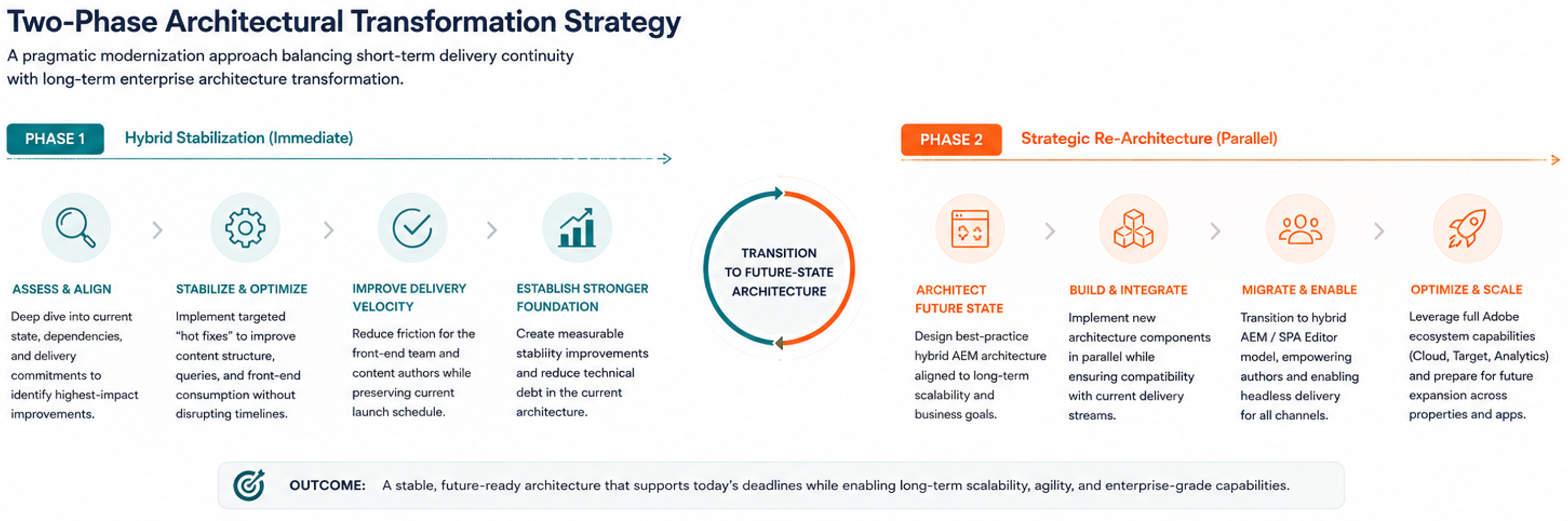
Rather than proposing a disruptive rebuild that would halt delivery momentum, Emberlight recommended a phased modernization strategy balancing immediate progress with long-term technical excellence.
Immediate Priorities
Long-Term Priorities
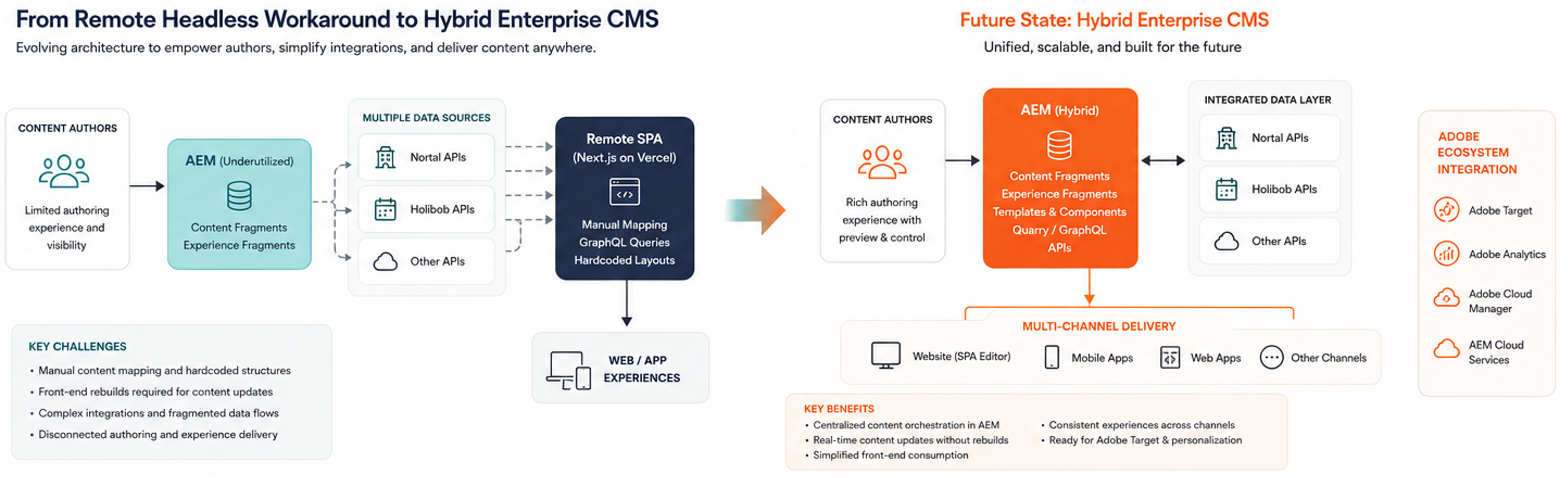
One of the most technically demanding aspects of the engagement was designing for a platform where digital experiences depended on multiple external systems.
Content was not exclusively authored in AEM. Instead, experiences were composed from a combination of:
This created a fragmented data landscape where the front-end was responsible for integrating multiple sources in real time.
Our Approach
Emberlight Global redefined AEM’s role within the ecosystem, positioning it as the central orchestration layer responsible for aggregating, normalizing, and delivering content in a consistent format.
Instead of pushing complexity downstream, the architecture absorbed it upstream, creating a cleaner, more scalable system.
What This Enabled
The phased approach allowed the team to improve the platform without interrupting delivery, delivering measurable gains in both technical performance and team efficiency.
Delivery Outcomes:
Operational Improvements:
These improvements created immediate value while setting the stage for deeper transformation.
Beyond short-term improvements, the engagement established a clear path toward a scalable, enterprise-ready architecture capable of supporting future growth.
Architectural Outcomes:
Future Capabilities Enabled:
The result was not just a stabilized implementation, but a future-ready platform designed to evolve with the organization’s digital ambitions.
Through our collaboration with Digital Arts Network Auckland, Emberlight Global helped transform a workaround-driven AEM implementation into a structured, scalable content platform, balancing immediate delivery needs with long-term architectural integrity.